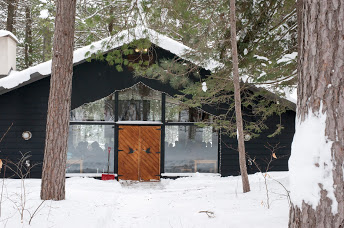
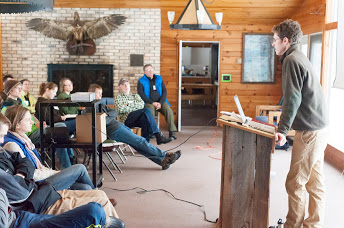
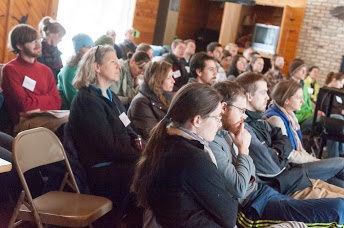
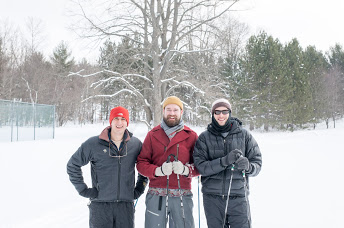
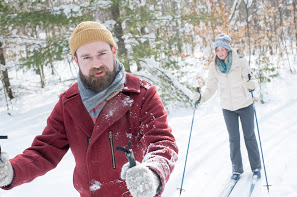
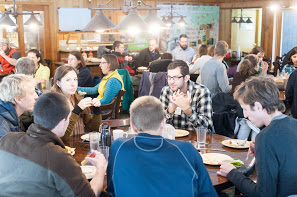
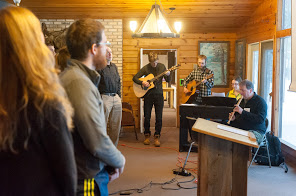
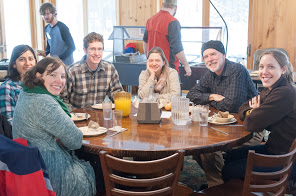
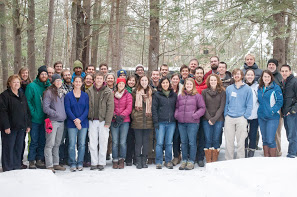
This last January we had the annual graduate fellows retreat. We had 35 fellows from 14 different chapters and universities converge on the Au Sable campus in Mancelona, MI for a time of fellowship and fun in the snowy north woods.
1 Comment
Every January, the Au Sable Graduate Fellows venture up to Northern Michigan for a weekend of conversation, worship, and time spent in creation, all through the focus of Christian environmental stewardship.
More information will be coming , but here are the basics for this year’s retreat: Where: Au Sable Institute, northern Michigan campus When: January 16th-18th (MLK Day weekend) Speaker: TBA 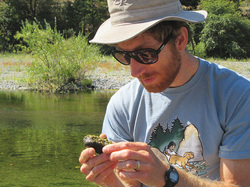 Keith Bouma-Gregson, a PhD student at UC Berkeley, was recently featured in a local California news journal regarding his research. Part of Keith’s research involves monitoring algal blooms in the Eel River, a river that runs through Humboldt. The algae has been of particular interest and concern, as some of the algae—specifically certain cyanobacteria—is potentially lethal. Keith will be spending the next several summers collecting algae samples, analyzing toxicity, and, with the collaboration of other local groups and the general public, hopefully arriving at some conclusions as to what is causing the toxic blooms.
Read more about Keith’s research and partnership work investigating the causes of the cyanobacteria! (photo by Jacob Shafer) The 2012-13 academic year is wrapping up and Au Sable Grad Fellows are heading into a variety of adventures, many overseas or involving face-to-face encounters of the natural kind. Here's a run-down of Fellows activities for Summer 2013.
Erin O'Brien (Michigan) is spending the first part of the summer in Greece taking in Greek culture while she conducts research for a professor's project in the School of Natural Resources and Environment. The project involves land use and biodiversity, so she will be counting birds as she enjoys the Greek countryside. Kiara Jorgenson will be reading for her comprehensive exams this summer from northern Minnesota. For five generations her husband's family has run and owned a small summer fishing resort off of Moose and Deer Lakes in Deer River, MN. Since its inception Shady Shore has been a locally sustainable, eco-friendly business, which Kiara and her husband and I now run. (Check it out at: www.shadyshoreresortmn.com) Heather Lumpkin (Wisconsin-Stevens Point) is finishing Masters in Natural Resource Environmental Education and Interpretation this spring. In mid-June she begins a new position as the Research and Monitoring Coordinator for the North Lakeland Discovery Center in Manitowish Waters, WI. She is delighted with this opportunity to use her background in field ecology research and environmental education. Janet Barclay (Cornell) will be finishing her MS in Biological and Environmental Engineering this summer. Her thesis focuses on developing a watershed-wide model of de-nitrification rates and exploring how those rates may be effected by climate change. She is planning to move to northeastern Connecticut this summer and is currently applying for jobs with Environmental Engineering firms in the area. Brian Flanagan (Cornell) will attend the Xth Mango Symposium in the Dominican Republic in June, presenting a research poster on small-scale farmer mango production in Haiti. He will then travel to Haiti to visit friends and family. The remainder of the summer will be spent in Ithaca NY awaiting the birth of their first child (hopefully mid July!) and finish writing his master's thesis with a plan to graduate by August. Jesse Antuma (Michigan) will be conducting research in Prof. Cardinale's lab at the School of Natural Resources that involves canoeing the Muskegon, Au Sable and Huron rivers looking at river bank erosion rates as they correlate with riparian flora diversity. This research will require a lot of plant identification and core sampling. Given the location of these rivers, particularly the Muskegon and Au Sable rivers, Jesse will be staying in the field (camping) for the majority of each week. Aaron Iverson (Michigan) is finishing up his extended (since Feb) field season in Puerto Rico. With wife Emily, Aaron is living in the central mountains and visiting coffee farms throughout the region where he is studying the role of local and landscape diversity on ecosystem services, specifically biological control. They are also finding the occasional day to get to the beach or explore a forest. Keith Bouma Gregson (California-Berkeley) will be conducting field research on algal ecology in the Eel River of Northern California to investigate the presence of cyanobacteria and cyanotoxins in the river. He is also working with the Eel River Recovery Project to help develop a citizen's science river monitoring program in the watershed. He also has plans to climb Half Dome this summer along with other climbing adventures. Derek Roserberger (Minnesota) will be counter-cultural this summer. While most people fend off the insects, Derek will be actively attracting them! He is spending several weeks in the Black Hills of South Dakota, graciously hosted by the Wheaton College science station, conducing research on the attraction and acceptance of novel eastern pine hosts by mountain pine beetles. Michelle Jackson (Wisconsin) is moving to Vancouver, British Columbia, to start a postdoc in the Forestry Department at the University of British Columbia. She'll be studying the effects of climate change on alpine systems, particularly focusing on habitat for White-tailed Ptarmigan and Vancouver Island marmots (two species endemic to Vancouver Island). She also plans to strengthen a citizen science monitoring program for these species and explore new ways to communicate climate change science to diverse audiences. David Young (Michigan State) will be working in Maine as an interpretive park ranger at Acadia National Park. Among other things, he'll be leading ranger-led boat trips, bike rides, hikes, and campground programs to further the mission of the National Park Service. That involves helping visitors better understand the world around while helping them make personal connections to the resources, with the end goal of sending visitors home as better care takers of God's world. Anna Novaroske (Purdue) will be in West Lafayette do lab work, screening for fungicide sensitivity levels. She will be in her first season of field work, conducting an experiment looking at the application timing of a fungicide to control Fusarium Head Blight in wheat. Amanda Lewis (Michigan State) continuing her doctoral dissertation research on the history of conservation and the Maasai in the Amboseli ecosystem in Kenya. She received a Fulbright-Hays Doctoral Dissertation Research Abroad grant and a National Science Foundation Doctoral Dissertation Research Improvement grant to complete her research. Mandy will be interviewing Maasai pastoralists, scientists, conservationists, and wildlife managers, collecting oral histories of their experiences. Bethany Laursen (Wisconsin) will finish her degree! The final stretch to an M.S. in Environment & Resources and Forestry will involve finishing a qualitative and social network data analyses, writing the thesis, defending, and presenting results to local and statewide stakeholders. She will be looking for gainful employment in the fall involving environment, communities, students, and coordinating anything. Amanda McMillan (Wisconsin) will be exploring Gulu, Uganda as a potential dissertation research site. While there, she will be introduced to her two new nephews and stay with her sister and her family who are missionaries in Gulu with Action International. On the way to Africa, she will visit some friends in England and France from my A Rocha days. Amanda defended her master's thesis this past semester and will take the first of two doctoral prelims when she returns from Africa. Allison Green (Michigan) will be spending the summer working through data from a recent research trip to a small-scale gold mining community in Ghana. She'll be sneaking away from the computer screen as much as possible to help out at the UM Campus Farm and other gardens around town in order to keep her sanity and enjoy all the fruits (and vegetables!) of summertime in Michigan. Will Pluer (Cornell) will be continuing his research on treatment of excess nutrients in agricultural runoff here in Ithaca. He is scheduled to present preliminary results at a conference in Kansas City in July. There will also be a visitor with a brother in South Africa for a little vacation time. Josh Miller (Michigan) recently completed his MS in Environmental Science at the University of Michigan and will be spending the summer in southeast Michigan volunteering for the Huron River Watershed Council and seeking a full-time position promoting the sustainable use of Michigan's natural resources. In the meantime, he and his family will be working in the garden. Erica Boldenow (Michigan) will be continuing her lab research on Group B Streptococcus (GBS) infections during pregnancy and the impact that environmental contaminants may have on GBS infection. She will be presenting some of her findings at a conference in Boston at the end of May. She also plans to escape the lab and spend some time outdoors. Brian Schaap (Michigan) is spending the first half of the summer in Tanzania conducting research on community forestry with fellow students for their master's project. After returning in July Brian be working as an environmental policy intern with the Michigan Department of Environmental Quality (DEQ) for the remainder of the summer. Sarah Brey (Michigan) will be living in a place she loves and learning about loving a place! She will be working at a bison ranch in southwestern South Dakota in the White River Badlands where her primary role will be the preservation and historic designation of a homestead here, along with basic ranch-hand duties. During this time, she will be learning from people who manage the land for whole, ecological health - people who are critical to the future of conservation in working, public, and private landscapes. Jennifer Stenglein (Wisconsin) will continue her work on her dissertation at University of Wisconsin - Madison where she studies the population dynamics of Wisconsin's wolf population. Since the advent of the wolf hunt, she is working closely with Wisconsin Department of Natural Resources to model the effects of proposed wolf harvest scenarios. That work will continue throughout the summer. She and her fiance will be married this summer and will enjoy their time together gardening and exploring Wisconsin. Leah Zimmerman (Michigan) will be interning in New York City in JP Morgan's Finance Associate Leadership Program, which is a corporate finance rotational program. This is part of her joint program between Michigan's School of Natural Resources and Environment and the Ross School of Business. |
AuthorsThe Fellows Archives
March 2015
Categories |


 RSS Feed
